Generate
Create images with AI
Children's Science Activities Guide
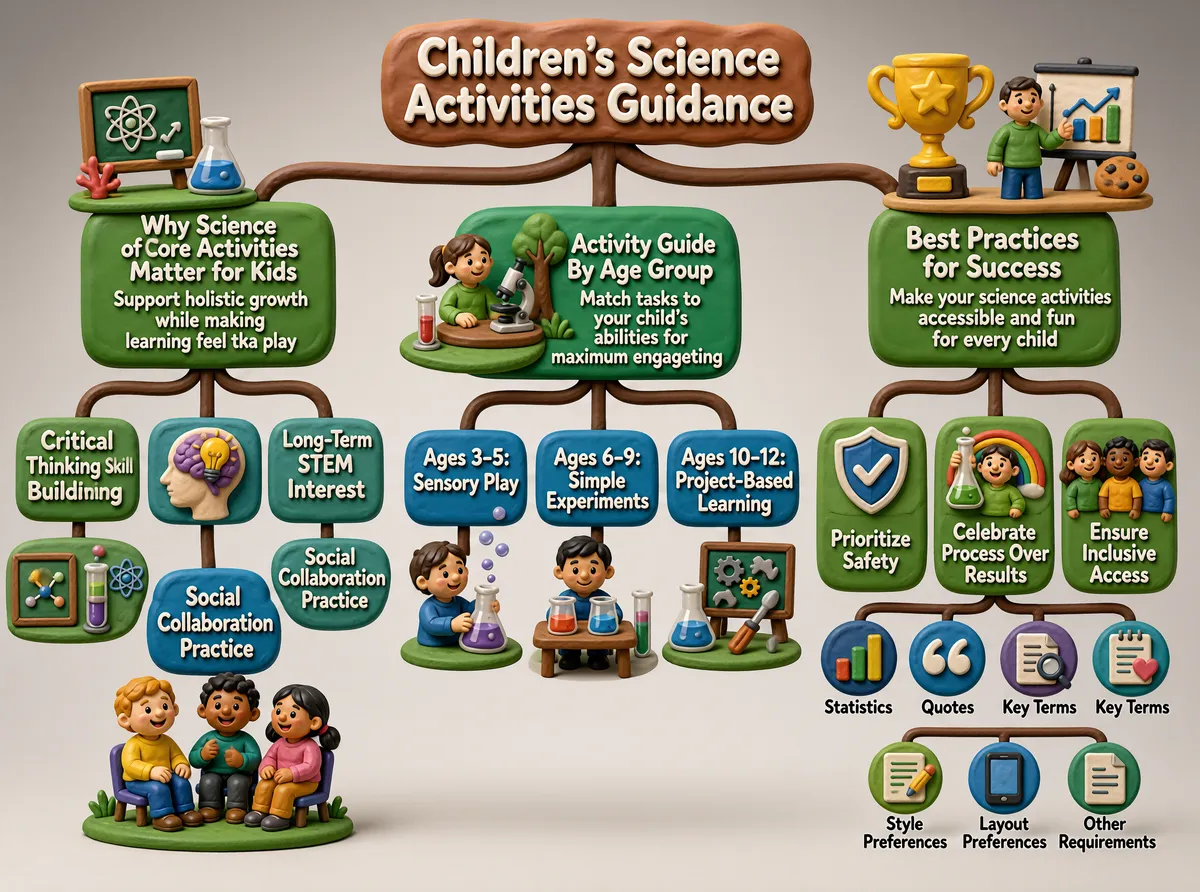
The infographic, titled **"Children's Science Activities Guidance"**, is designed in a playful, three-dimensional clay or modeling dough aesthetic, with rounded brown branches connecting various sections against a light gray background. The overall layout is hierarchical and tree-like, branching out from the main title into three primary categories: **Core Benefits of Children's Science Activities**, **Age-Appropriate Science Activity Types**, and **Best Practices for Implementing Science Activities**. Each section features colorful, textured green and blue rectangular nodes with white text, accompanied by small 3D figurines and icons that visually represent the content. --- ### **Main Title:** - **Children's Science Activities Guidance** — displayed in raised white letters on a large, irregularly shaped brown clay plaque at the top center. --- ### **Section 1: Core Benefits of Children's Science Activities** This branch extends to the left and includes four sub-nodes: 1. **Why Science Activities Matter for Kids** - Text: *Support holistic growth while making learning feel like play* - Visuals: A chalkboard with an atom symbol, a beaker with blue liquid, and small red coral-like shapes on a green base. 2. **Critical Thinking Skill Building** - Visuals: A side-profile human head with a purple brain containing a yellow lightbulb. 3. **Long-Term STEM Interest** - Visuals: A framed molecular structure, test tubes with colored liquids, and a blue atom icon. 4. **Social Collaboration Practice** - Visuals: Three children sitting together on chairs, smiling and interacting. --- ### **Section 2: Age-Appropriate Science Activity Types** This central branch contains an overarching node and three age-specific sub-nodes: - **Activity Guide By Age Group** - Text: *Match tasks to your child's abilities for maximum engagement* - Visuals: A girl at a table with a microscope and beakers, a tree, and grass. - **Ages 3–5: Sensory Play** - Visuals: A boy holding a beaker with purple liquid; bubbles float above him. - **Ages 6–9: Simple Experiments** - Visuals: A boy sitting at a table with two beakers (one red, one blue) and a test tube. - **Ages 10–12: Project-Based Learning** - Visuals: A board with gears and a wrench, a beaker, and tools like a hammer and screwdriver. --- ### **Section 3: Best Practices for Implementing Science Activities** This right-hand branch begins with a main node: - **Best Practices for Success** - Text: *Make your science activities accessible and fun for every child* - Visuals: A golden trophy with a star, a person presenting a graph on a whiteboard, and a cookie. Below this are three key principles: 1. **Prioritize Safety** - Visual: A shield with a checkmark. 2. **Celebrate Process Over Results** - Visual: A child holding a beaker with green liquid, standing in front of a rainbow. 3. **Ensure Inclusive Access** - Visual: Three children of diverse appearances standing together. Beneath these principles, six smaller circular icons represent additional content categories or requirements: - **Statistics** — Bar chart icon. - **Quotes** — Quotation marks icon. - **Key Terms** — Document with magnifying glass icon. - **Style Preferences** — Notepad with pencil and heart icon. - **Layout Preferences** — Smartphone/tablet screen icon. - **Other Requirements** — Plain document icon. --- ### **Overall Style and Design Elements:** - The entire infographic uses a tactile, handcrafted clay aesthetic with soft shadows and rounded edges. - All text is rendered in a clean, sans-serif font, embossed in white for contrast against the brown, green, and blue backgrounds. - Color palette includes earthy browns, vibrant greens, blues, and pops of color (red, yellow, purple) in icons and figures. - The connections between nodes are thick, brown, branch-like lines that mimic organic growth, reinforcing the “tree” metaphor. This infographic serves as a comprehensive, visually engaging guide for educators and parents, emphasizing the importance of science education for children through developmentally appropriate, safe, and inclusive practices.
Tags
More Images