Generate
Create images with AI
Large Language Model Infographic
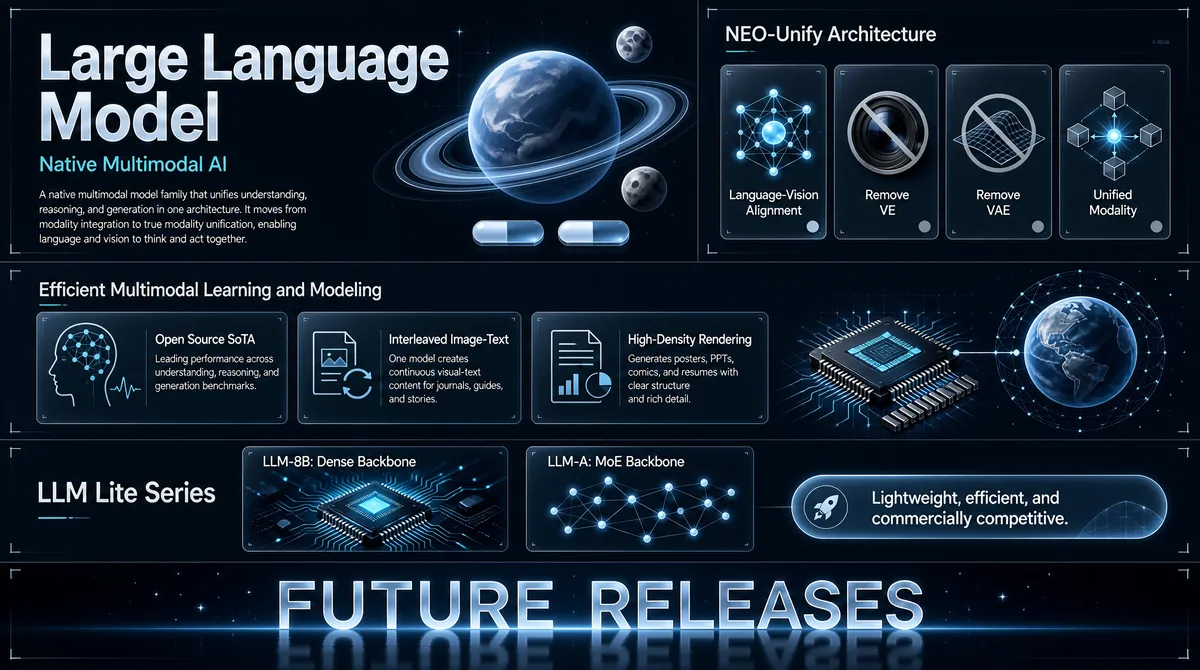
The title of this infographic is "Large Language Model". and adopts a refined futuristic dark-mode glassmorphism aesthetic with desaturated icy cyan highlights, deep navy space ambience, silver-blue planetary lighting, and a premium sci-fi product presentation style. The overall layout is a 16:9 horizontal widescreen infographic dashboard, divided into three major horizontal bands plus a cinematic footer, with a background of deep obsidian navy, subtle starfield particles, faint nebula haze, light gray technical grid overlays, soft halftone shadows, and controlled cyan glow. At the upper-left hero area, place the massive title in a bold condensed sans-serif font with pale ice-blue glow and beveled luminous edges. Directly beneath it, place the subtitle "Native Multimodal AI" in a smaller clean sans-serif font. Below the subtitle, set a concise introductory paragraph in crisp white sans-serif text with generous line spacing: "A native multimodal model family that unifies understanding, reasoning, and generation in one architecture. It moves from modality integration to true modality unification, enabling language and vision to think and act together." To the right of this hero text, render a large blue-gray ringed planet with swirling cloud texture, three translucent orbital rings, one small cratered moon above, and one smaller rocky planet below. Beneath the planet, add two empty rounded pill-shaped buttons with pale blue glass gradients and no text. In the upper-right architecture zone, place the heading "NEO-Unify Architecture" in an elegant serif typeface. Below it, arrange four dark glass cards in a horizontal row. The first card contains a glowing neural lattice made of connected nodes and a central cyan core, labeled "Language-Vision Alignment". The second card shows a detailed camera lens crossed by a prohibition slash, labeled "Remove VE". The third card shows a wireframe variational surface diagram crossed by a prohibition slash, labeled "Remove VAE". The fourth card shows cubic semantic blocks connected to a central radiant node with bidirectional flows, labeled "Unified Modality". Each card includes a small muted sage-gray circular status dot at the lower-right. Across the middle band, place the heading "Efficient Multimodal Learning and Modeling". Under the heading, align three glass information panels on the left. The first panel includes a head silhouette filled with neural nodes and a small waveform graph, with the text "Open Source SoTA: Leading performance across understanding, reasoning, and generation benchmarks." The second panel includes a document-and-image symbol with circular exchange strokes, with the text "Interleaved Image-Text: One model creates continuous visual-text content for journals, guides, and stories." The third panel includes a report sheet with chart bars and a pie chart, with the text "High-Density Rendering: Generates posters, PPTs, comics, and resumes with clear structure and rich detail." To the right, place a hyper-detailed quantum processor chip with glowing cyan circuitry and metallic pins, connected visually to a holographic blue planet wrapped in a digital wireframe sphere. In the lower band, place the heading "LLM Lite Series" on the left. To its right, create two large model cards. The left card contains a dense illuminated microchip grid and the label "LLM-8B: Dense Backbone". The right card contains a sparse glowing node network and the label "LLM-A: MoE Backbone". On the far right, add a long rounded highlight banner with a circular rocket illustration and the text "Lightweight, efficient, and commercially competitive." At the bottom footer, render "FUTURE RELEASES" in massive fragmented luminous typography, reflected on a glossy dark energy-field horizon line, with small star flares and a thin horizontal divider. Keep all typography sharp, all panels cleanly separated, and the color palette restrained, cool, cinematic, and non-saturated.
Tags
More Images