Generate
Create images with AI
Photosynthesis Light Energy Conversion Diagram
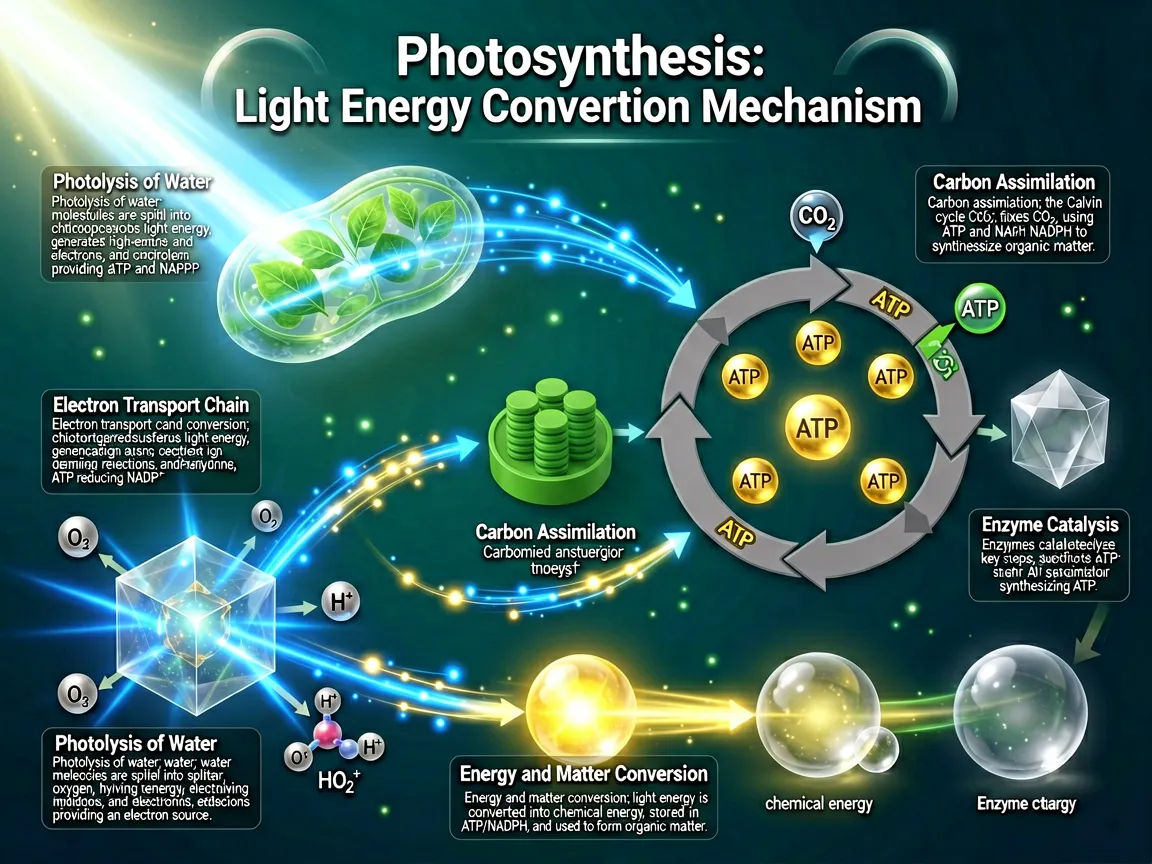
This infographic is titled "Photosynthesis: Light Energy Conversion Mechanism." It features a deep blue-green background, supplemented by glowing particles, energy flow lines, and translucent structures, creating a visual atmosphere that intertwines a sense of technology with the vitality of life. The overall layout follows a left-to-right and top-to-bottom flow structure, clearly presenting the core pathway of photosynthesis, in which light energy is converted into chemical energy and used to synthesize organic matter. Through visual elements such as dynamic light trajectories, molecular models, circular cycle diagrams, and three-dimensional geometric forms, together with explanatory text boxes, the diagram systematically illustrates the key steps of the two major stages: the light reactions and the dark reactions. The title is located at the top center of the image, rendered in bold white typeface and decorated with two semicircular halos, highlighting the theme. The entire process begins on the left side and sequentially passes through five core stages: "Photolysis of Water," "Light Energy Capture and Conversion," "Electron Transport Chain," "Carbon Assimilation," and "Enzyme Catalysis," ultimately converging at the bottom in a concluding description of "Energy and Matter Conversion." The detailed content of each part is as follows: 1. **Photolysis of Water** (lower left): - Text in the text box: "Photolysis of water; water molecules are split into oxygen, hydrogen ions, and electrons, providing an electron source." - Visual elements: a transparent polyhedral structure (symbolizing Photosystem II or thylakoid membrane), surrounded by blue light beams, from which multiple O₂ molecules (diatomic spheres), H⁺ (small spheres with positive charge symbols), and HO₂⁺ (a molecular structure labeled "HO₂⁺") are released, with arrows indicating the direction of decomposition. 2. **Light Energy Capture and Conversion** (upper left): - Text in the text box: "Light energy capture and conversion; chlorophyll absorbs light energy, generates high-energy electrons, and produces ATP and NADPH." - Visual elements: a translucent elliptical chloroplast structure, embedded with multiple green leaf-shaped patterns (symbolizing chlorophyll molecules), illuminated by bright blue-white light, from which electron streams (blue light spots moving along curved paths) are emitted. 3. **Electron Transport Chain** (middle-left): - Text in the text box: "Electron transport chain; electrons are transferred successively, driving redox reactions and reducing NADP⁺." - Visual elements: an arc-shaped pathway composed of blue and golden light spots, connecting the light energy capture area to the ATP/NADPH generation region, symbolizing the electron flow path. Beside the pathway is a green disc-shaped structure containing stacked green cylinders (possibly representing cytochrome complexes or carrier proteins). 4. **Carbon Assimilation** (circular structure on the right): - Text in the text box: "Carbon assimilation; the Calvin cycle fixes CO₂, using ATP and NADPH to synthesize organic matter." - Visual elements: a large circular cycle diagram composed of multiple gray arrows, with several golden spheres labeled "ATP" distributed within the cycle, a CO₂ input arrow above the cycle on the outside, and an NADPH input arrow on the right side, indicating its participation in the carbon fixation process. Extending from the right end of the circular structure is a transparent polyhedral crystal (symbolizing carbohydrates or other organic products). 5. **Enzyme Catalysis** (far right): - Text in the text box: "Enzyme catalysis; enzymes catalyze key steps, such as ATP synthase synthesizing ATP." - Visual elements: located to the right of the carbon assimilation circular structure, with no direct graphical connection, but its position implies its regulatory role throughout the entire process, emphasizing the catalytic function of enzymes at key steps. 6. **Energy and Matter Conversion** (bottom center): - Text in the text box: "Energy and matter conversion; light energy is converted into chemical energy, stored in ATP/NADPH, and used to form organic matter." - Visual elements: three transparent spheres of varying sizes, one of which emits a yellow glow and is labeled "chemical energy," symbolizing the stored form of energy, while the other spheres are connected by light beams, representing the outcome of energy and matter conversion. In addition, the diagram includes the following details: - Glowing lines and particle flows are used in multiple places to indicate the direction of energy flow. - ATP and NADPH appear as golden spheres and labels, highlighting their roles as energy carriers. - Chemical substances such as CO₂, O₂, H⁺, and HO₂⁺ are all marked with molecular models or symbols. - The overall style has a futuristic, technological feel while also maintaining biological accuracy, making it suitable for educational or science popularization contexts. Through its structured layout, clear textual explanations, and intuitive visual symbols, this diagram comprehensively reproduces the entire process by which light energy is converted into chemical energy and used to synthesize organic matter in photosynthesis, with rigorous logic and clear hierarchical organization.
Tags
More Images