Generate
Create images with AI
Solar Orbit GPU Compute Cluster Concept
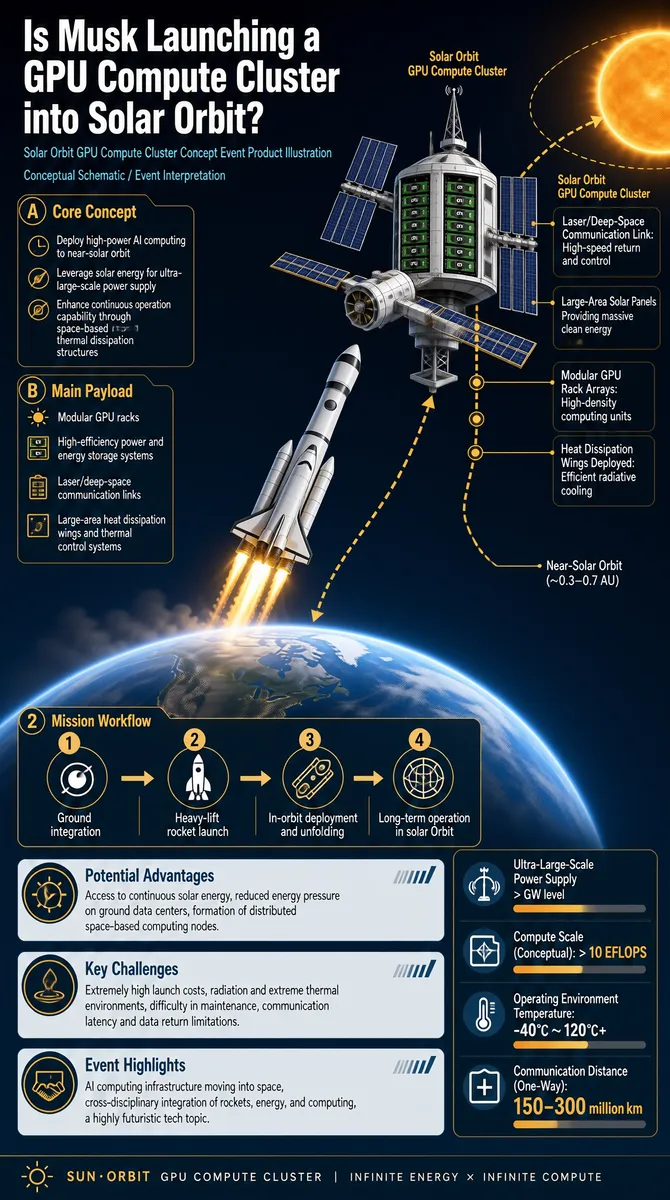
This is a Chinese-dominated 16:9 horizontal technology infographic, with the theme "Is Musk Launching a GPU Compute Cluster into Solar Orbit?" The overall design uses a deep blue-black cosmic background, complemented by gold, white, orange, and blue highlights, presenting a high-end tech product illustration style. The image is not a traditional statistical chart but a conceptual explanatory infographic, organizing content through information cards, numbered processes, icons, orbital dashed lines, callout labels, and parameter bars. The title area at the top left includes: Main title: Is Musk Launching a GPU Compute Cluster into Solar Orbit? Subtitle: Solar Orbit GPU Compute Cluster Concept Event Product Illustration Tags: Conceptual Schematic / Event Interpretation Main visual of the image: In the center is a white heavy-lift rocket ascending from above the Earth, tilting upward to the right, with a bright flame trailing from its tail. The Earth is positioned in the lower-middle section, showing a blue atmosphere, surface curvature, and night lights. At the upper right is the "Solar Orbit GPU Compute Cluster," which resembles a combination of a space station and a server data center, composed of GPU rack arrays, solar panels, communication antennas, thermal control structures, and trusses. At the far right is a large orange-yellow Sun, with a dashed near-solar orbital arc beside it. A golden dashed orbit connects the Earth, rocket, space computing platform, and solar orbit, indicating the launch and deployment path. The information modules on the left are as follows: A Core Concept Deploy high-power AI computing to near-solar orbit Leverage solar energy for ultra-large-scale power supply Enhance continuous operation capability through space-based thermal dissipation structures B Main Payload Modular GPU racks High-efficiency power and energy storage systems Laser/deep-space communication links Large-area heat dissipation wings and thermal control systems C Mission Workflow This area is a horizontal 4-step process, organized with numbers, icons, and arrows: 1 Ground integration 2 Heavy-lift rocket launch 3 In-orbit deployment and unfolding 4 Long-term operation in solar orbit The information modules at the bottom are as follows: Potential Advantages: Access to continuous solar energy, reduced energy pressure on ground data centers, formation of distributed space-based computing nodes Key Challenges: Extremely high launch costs, radiation and extreme thermal environments, difficulty in maintenance, communication latency and data return limitations Event Highlights: AI computing infrastructure moving into space, cross-disciplinary integration of rockets, energy, and computing, a highly futuristic tech topic Callouts on the right-side space computing platform include: Solar Orbit GPU Compute Cluster Laser/Deep-Space Communication Link: High-speed return and control Large-Area Solar Panels: Providing massive clean energy Modular GPU Rack Arrays: High-density computing units Heat Dissipation Wings Deployed: Efficient radiative cooling Near-Solar Orbit: (~0.3–0.7 AU) The parameter bars at the lower right include four icon-style metrics: Ultra-Large-Scale Power Supply: > GW level Compute Scale (Conceptual): > 10 EFLOPS Operating Environment Temperature: -40°C ~ 120°C+ Communication Distance (One-Way): 150–300 million km Decorative English footer text at the bottom: SUN·ORBIT GPU COMPUTE CLUSTER | INFINITE ENERGY × INFINITE COMPUTE
More Images